
Sugar Land City Directory Collections
The historical shelf for a Sugar Land directory search is wider than a single printed run. Fort Bend Libraries places its Genealogy & Local History resources at George Memorial Library in Richmond. Its online obituary database, burial volumes, newspapers on microfilm, and local-history support are the strongest documented family routes. The Texas State Library and Archives Commission also explains where historical-directory research can continue through open shelves, catalogs, and partner collections. Its inspected holdings list did not show a standalone Sugar Land run, so a Houston volume or statewide list cannot be treated as proof that a Sugar Land household entry exists.
| Collection | Years | Where Held | Access |
|---|---|---|---|
| Fort Bend Herald-family obituary database | 1909 to present across four newspaper titles | Fort Bend Libraries online, with George Memorial support | Name, date, cemetery, and keyword search; scans appear when available |
| Fort Bend Burial Records | Five 1997 volumes, a 2004 supplement, and a later supplement | George Memorial Library, second floor | On-site burial and cemetery leads, not a current-address source |
| Standalone Sugar Land household directories | No run located in inspected official holdings | TSLAC catalog and open shelves; UNT, UT, and library catalog routes | Search regional holdings before claiming household coverage |
| Reverse or criss-cross directories | No Sugar Land-specific run located in inspected official sources | TSLAC, UT, UNT, and library catalogs | Catalog lead only until a local volume is identified |
| Digitized town and post-office lists | Examples inspected for 1898, 1906-07, 1918, 1938, and 1942 | UNT Portal to Texas History | Free online place-name and postal context, not household entries |
| Rice Sugar Land archival series | 1827 to 2006 | Rice Woodson Research Center, off-site retrieval | Request material through the archive |
Use the collection name and date in every note. A cemetery lead, obituary citation, marriage index, map, or deed may help identify the right household, but each answers a different question. The Fort Bend County Info Index can help locate official public or court material, yet it is a finding aid rather than the custodian. When a volume is not online, the fallback is the library catalog, an on-site visit, or an archival request, not a guess about what the volume contains.
Note: A historical directory label can describe a regional collection, while the entry itself may name a different postal town or county location.
Sugar Land Directory-Source Gap
The most useful result is sometimes a clear limit. The inspected TSLAC historical-directory holdings did not list a standalone Sugar Land household run, and official sources did not verify a local reverse or criss-cross run. That does not mean residents left no record. It means the search should shift to sources that actually identify people, events, or locations, such as the Fort Bend obituary database, county marriage records, census material, newspapers, and recorded instruments. Calling an unverified regional volume a Sugar Land directory would turn a catalog lead into a false claim.
The contrast is visible in the digitized material. The 1906-07 UNT town-list page shows Sugar Land as a Fort Bend place name in a directory-style publication. It does not show a person, street, spouse, telephone number, or household. Preserve its title, year, page, county context, and postal context. Then use those details to search other dated records. The local quirk is that a Sugar Land name can be easy to find in a historical directory-shaped source while an actual household run has not been confirmed.
Another comparison matters. A printed directory commonly captures publication-period information, while a census is a decennial household snapshot and an obituary is a later family notice. None can be silently substituted for the others. Pairing records is stronger than stretching one result past its limits.
Sugar Land Directory Research Room
George Memorial Library's Genealogy & Local History collection is the central local access point for Sugar Land historical-directory research. The collection is on the library's second floor at 1001 Golfview Drive in Richmond. It lists local newspapers and microfilm, burial records, the obituary database, Chronicling America, FamilySearch instruction, and in-library Ancestry Library Edition. Microfilm readers and printers are available. The inspected guide listed coin-operated copies at 10 cents per page, but hours and service details should be confirmed before a visit.
The library gives several access channels when a name search does not resolve online. Search the obituary database from home first. At the library, check burial material, newspaper microfilm, and available subscription tools. Ask for help locating the right collection, then cite the underlying newspaper, county document, or archival item rather than treating a finding aid as the final record. The collection focuses on Fort Bend and nearby counties, which is useful when a historical Sugar Land address falls outside a modern city label.
The library's local-history page identifies the research collection and its access conditions.
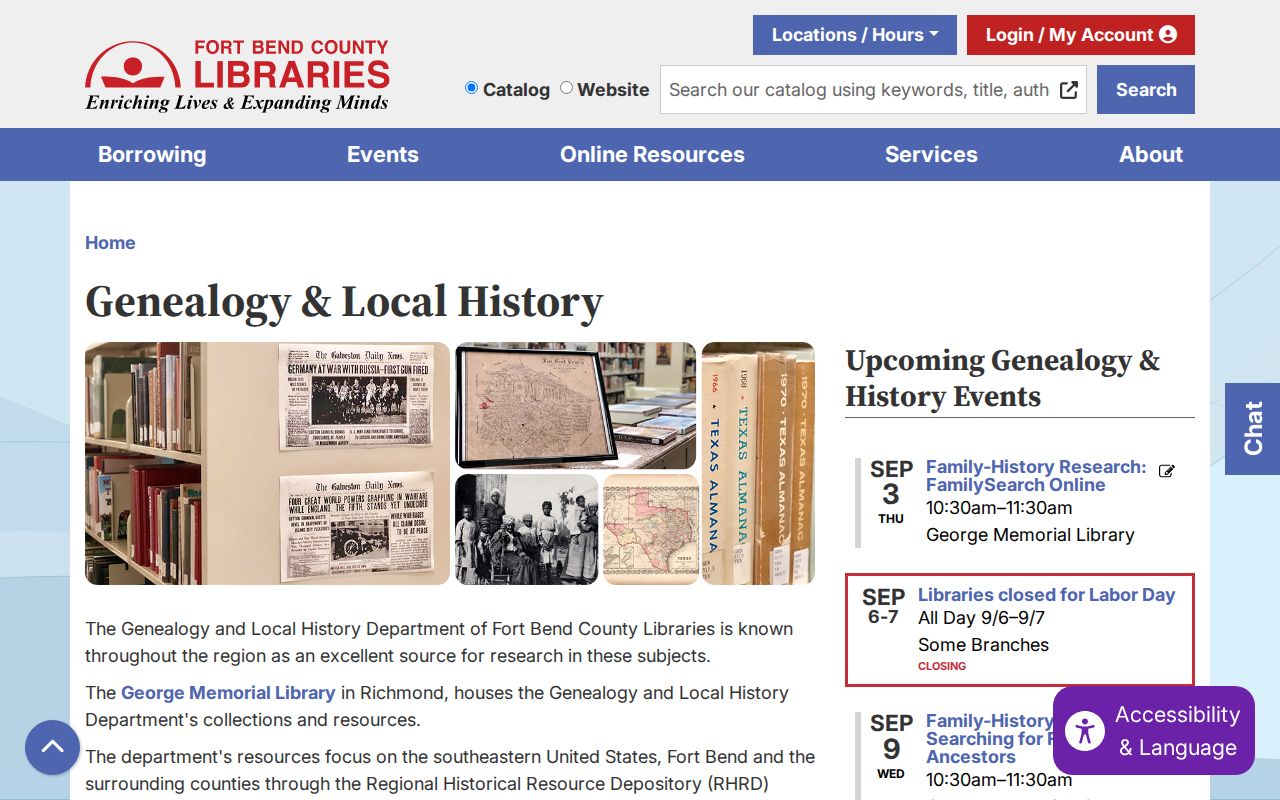
The research room is a practical place to move from a historical-directory question to dated newspapers, burial records, and local indexes.
Sugar Land Record-Keeping Timeline
Directory research needs a time line because Sugar Land sources span settlement, county, postal, and incorporated-city records. Early county material can reach back to 1821 in historic District Clerk series, while Fort Bend County was created in 1837. Sugar Land incorporated in 1959. A historic result may therefore describe a Fort Bend place or postal town rather than the present municipal boundary. The city’s 2017 annexation of Greatwood and New Territory adds another reason to retain the exact source date and jurisdiction.
- 1821-1838: Early county land and court material establishes the Richmond-based county record trail.
- 1898-1942: Digitized statewide post-office and town lists provide dated Sugar Land place-name evidence.
- 1909 to present: The Fort Bend Herald-family newspaper coverage provides an obituary route, although coverage and scans are incomplete.
- 1959: Sugar Land incorporation marks the point when city files join older county, newspaper, cemetery, and map sources.
- 2017: Annexation changes make an older postal or jurisdiction label worth preserving rather than rewriting.
The digitized 1906-07 Texas town-list page is a dated example of the earlier place-name layer.
The image supports a place-and-year citation. It does not support a household conclusion, so it belongs beside census, newspaper, cemetery, or county evidence.
Reading Sugar Land Directory Evidence
A verified local household volume must be read as a period record, not as a modern profile. TSLAC notes that period directories often carry a name, address, telephone, spouse, business-affiliation notation, and ownership or occupancy notation. Those fields are useful only if they appear in the particular volume. For the documented Sugar Land town-list page, the inventory is narrower: place name, county association, postal-list context, page, volume, and year. No resident name or street field can be filled in from that page.
| Name | Record the spelling exactly when a verified household entry supplies one; the inspected Sugar Land town list does not. |
|---|---|
| Address | Keep the printed street and number as historical text, then compare it with maps or county records before modernizing it. |
| Spouse or business notation | Capture only when the volume prints it. It can distinguish same-name people but is not proof beyond the publication date. |
| Telephone or occupancy notation | Preserve the exact abbreviation and consult the volume key before drawing a conclusion. |
| Town-list fields | For the documented local example, capture Sugar Land, Fort Bend context, publication year, volume, and page. |
- Criss-cross directory
- An address-ordered directory that can point from a street to listed occupants. A Sugar Land-specific run was not verified in the inspected sources.
- Householder index
- A name index intended to identify the head or listed member of a household. It is useful only when the volume and its coverage are known.
- Abbreviation key
- The publisher's explanation of shortened labels. Photograph or transcribe it before interpreting an entry.
Note: A complete citation includes the collection title, publication year, page, repository, and the exact field actually displayed.
Sugar Land Directory Leads in Obituaries
When a standalone historical directory cannot be confirmed, the Fort Bend obituary database supplies a focused name-and-date route. Its published coverage notice identifies the Rosenberg Herald, 1909-1958; the Texas Coaster, 1912-1958; the Herald-Coaster, 1958-2007; and the Fort Bend Herald, 2007 to the present. Results may include a name, dates, cemetery, notes, and a scanned obituary. “O.O.F.” means on file. A missing result can mean no obituary was printed, an issue is unavailable, a record was not indexed, or the spelling differs.
The official obituary search tips document wildcard characters, Boolean operators, date filters, alphabetical browsing, cemetery lists, maiden-name terms, children, organizations, and war references. Search names in more than one form. Save the query and the date searched. If an item is found, compare it with burial material, a marriage index, a census entry, or a dated county record before treating two matching names as one person.
Burial Records can provide a second historical trail. The library describes five volumes issued in 1997, a 2004 supplement, and a newer compiling supplement. Cemetery and grave references help locate a record, but do not establish where a person lived at another time.
Tracing Sugar Land Directory Households
A careful Sugar Land historical-directory trail begins with the strongest dated entry and adds corroboration one record type at a time. The sequence below works even when the first item is an obituary or town list rather than a household directory. It keeps historical residence, family connection, ownership role, and city geography separate. For current address-keyed records, use the separate Sugar Land street lookup rather than treating a historical source as current evidence.
- Start with a dated name, place label, obituary result, or archival catalog item. Record the exact spelling and citation.
- Check the Fort Bend obituary database and Burial Records for dates, cemetery references, relatives, and available scans.
- Use marriage indexes, census material, and newspapers to test whether the name, place, and period fit the same family.
- Compare an address only after locating a verified household source, then preserve its original wording and date.
- Use a county recorder, court, GIS, or archival source to corroborate the historical trail without converting it into a claim of modern residence.
A person dropping out of an index is not a single answer. They may have moved, died, used another spelling, been omitted, or fallen into a gap in coverage. Mark an unresolved match as unresolved. That practice is especially important where the local directory run itself has not been found.
Sugar Land Directory Archive Routes
Archives widen the search when the library and online indexes run out. Rice University’s Sugar Land series spans 1827-2006 and measures 39.5 linear feet. The inventory includes correspondence, clippings, photographs, maps, newspapers, school, police, fire, church, directory, and resident-related material. It is held by the Woodson Research Center with off-site retrieval. Request material through the archive instead of assuming a particular name or address appears in it. The Jane McMeans papers inventory offers another Sugar Land and Fort Bend catalog route, subject to appointment, staff response, and copyright rules.
The Fort Bend Historical Commission is another documented contact path for archives, cemeteries, burial-name material, oral histories, and tours. Its office is at 301 Jackson Street, fifth floor, in Richmond. The inspected archive search was not consistently available, so ask for a finding aid by subject and date. The Historical Commission contact page identifies that route.
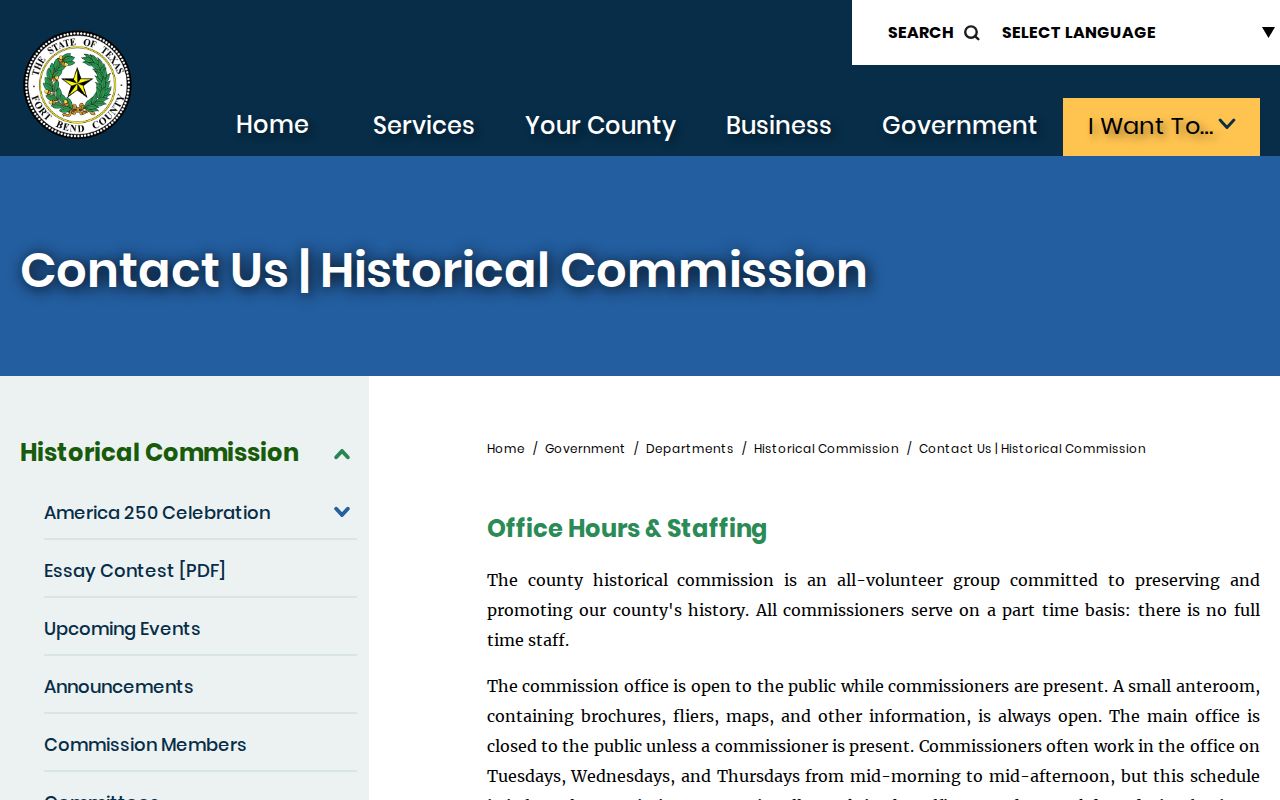
Archive and library sources complement each other: one gives cataloged local material, while the other supplies searchable obituaries, burial references, microfilm, and research access.