
Finding Sugar Land Residents
Sugar Land residents appear in separate city, county, and state records, not in one official roster. An address search usually starts with the Fort Bend appraisal record and GIS parcel, while a name search can begin with a deed party index, voter inquiry, obituary index, or court case. Each record answers a narrower question. An owner entry may identify an appraisal owner, and a deed identifies a grantor or grantee on its recording date. Neither fact alone proves who lives at the address now.
Keep the original spelling, address line, and date of each result. Sugar Land postal labels, parcel boundaries, and municipal limits do not always match. A useful resident lead has two independent identifiers, such as a parcel ID plus a dated instrument, rather than two search hits that repeat the same unsourced information.
- Use the known name, street, or historic date to choose the first custodian.
- Check the parcel record for a situs address, property identifier, and displayed owner role.
- Compare a recorder instrument or another dated official index before treating names as related.
- For older people, search library obituary and burial tools with spelling variants.
- Request an existing city or county record when the required period is not online.
Sugar Land Residents Custodians
Different custodians keep the records that function as Sugar Land resident sources. Fort Bend Central Appraisal District publishes the property search. The County Clerk records deeds, plats, liens, and related Official Public Records. Elections maintains individual voter inquiry, subject to statutory limits. Sugar Land City Clerk Open Records routes requests for existing municipal records. A countywide result needs a city, ZIP, situs, or subdivision check before it is treated as connected to Sugar Land.
The right office also depends on the record type. A marriage license is held by the county clerk where it was filed, a divorce decree by the district clerk where granted, and a state verification by DSHS. The next record should be selected for its ability to confirm a role or date, not simply because it is searchable.
Fort Bend County Clerk
Recording Division and Official Public Records custodian.
301 Jackson Street, Richmond, TX 77469-3108
281-341-8685
Fort Bend Central Appraisal District
County property, parcel, value, and owner-display search.
Use the current roll and preserve its tax-year label.
Fort Bend Elections
Individual registration inquiry, subject to protected-field rules.
Use a narrow identity check, not a block list.
Sugar Land Parcel Search Fields
The Fort Bend CAD property search is often the fastest way to connect a Sugar Land address to a parcel record. It offers owner-name, street-number, street-name, Quick Ref ID, Geographic ID, property type, subdivision, neighborhood, tax-year, DBA, and other controls. Simplify a name or address when the first try fails. Record the chosen tax year because a displayed value or exemption can change.
Use the parcel identifier as the bridge to GIS and the recorder. CAD itself warns that legal descriptions and acreage should be verified for legal purposes. That makes the appraisal entry a research starting point, not conclusive title or a current-residency finding.
| CAD field | Useful input | Why retain it |
|---|---|---|
| Owner Name | Text, simplified name | Shows the appraisal role displayed by CAD. |
| Street Number and Street Name | Address components | Finds a probable situs record. |
| Quick Ref or Geographic ID | Parcel identifier | Connects CAD, GIS, and deed research. |
| Subdivision or Neighborhood | Optional local narrowing | Helps distinguish repeated street names. |
| Tax Year | Selected roll year | Dates the values and exemptions shown. |
Note: A CAD owner display is an appraisal record, not proof of title or present occupancy.
Sugar Land Deed Party Trails
The County Clerk’s Official Public Records index provides a different Sugar Land residents trail. It can be searched by combined party, grantor, grantee, date filed, instrument number, document type, subdivision, lot, block, street address, town, or legal description. The instructions say party names are entered LASTNAME FIRSTNAME. A party hit is still an index lead until the document image is read.
Open the image and compare its recording stamp, instrument number, and legal description with CAD or GIS. Follow instruments forward when tracing an ownership sequence. The county describes online coverage in more than one way, including 1838-present and a separate 1821 reference, so the live index date should be preserved rather than assumed.
- Parcel
- A mapped piece of land identified by a CAD or GIS reference.
- Grantor
- The party transferring an interest in a recorded instrument.
- Grantee
- The party receiving the stated interest in that instrument.
- Index
- A searchable entry that points to a record, not always the record image itself.
Current Sugar Land Resident Sources
Current Sugar Land resident sources are best treated as role-specific directories. The appraisal roll is centered on property, the recorder indexes document parties, voter inquiry concerns registration, and city systems concern municipal activity. An obituary or business filing can be a useful historical or role lead, but neither replaces a current address confirmation. The resident lookup route works best when these roles remain separate.
Official sources are generally clearer about custodian, date, and access limit than commercial search categories. Commercial results can merge people or old addresses. A narrow official search with a second source is more useful for family history, estate questions, reconnecting, and checking a property record.
| Source | Role shown | Keeper | Access limit |
|---|---|---|---|
| CAD property record | Owner display, situs, parcel context | Fort Bend CAD | Current roll, research display. |
| Recorded instrument | Grantor, grantee, date, legal description | County Clerk | Index and image/copy route. |
| Voter inquiry | Registration concepts and status | Fort Bend Elections | Exceptions and protected identifiers apply. |
| Municipal record | Permit, inspection, code, or court context | City of Sugar Land | Custodian and date-range request may be needed. |
| Obituary database | Historical dates, cemetery, relatives | Fort Bend Libraries | Newspaper coverage and scans vary. |
Sugar Land Voter Record Limits
Fort Bend Voter Inquiry displayed search-method, VUID, date-of-birth, first-name, and last-name controls when researched. The dropdown labels and post-search result behavior were not confirmed, so those details should be checked live. Texas Election Code rules allow certain voter-list information while protecting Social Security, driver-license, and personal-identification numbers. Ballot choices are not voter-list fields.
Registration is not proof of current physical residence. A record can be inactive, confidential, or subject to a protected-address program. Do not infer anything from a missing result. Keep the lookup narrow, record the status date if displayed, and use only the minimum information needed for a legitimate personal records question.
Sugar Land Postal Geography
A Sugar Land mailing label is not the same thing as a city boundary. USPS material associates 77478, 77479, 77487, 77496, and 77498 with Sugar Land-related labels, while some combinations also use Stafford or Damon. Preserve the exact city line and ZIP that the original record shows, then check the parcel situs and jurisdiction for a final location decision.
The 2008 USPS bulletin recorded 15,571 deliveries moved from old 77478 Sugar Land to new 77498 Sugar Land. That change is valuable when an old deed, obituary, or directory entry seems inconsistent with a newer address. It is a postal-history fact, not evidence that a person moved or that city limits changed.
Note: ZIP geography can suggest where to investigate, but parcels and agency boundaries decide which custodian has the record.
Sugar Land City Record Requests
The Sugar Land Open Records route covers existing municipal material such as permits, code enforcement, inspections, agendas, ordinances, legal notices, and city-operated records. A request should identify a record, address, department, case number, incident number, or date range. Texas Public Information Act procedures do not require staff to answer a question, create a record, or perform legal research.
City Clerk Open Records lists City Hall at 2700 Town Center Boulevard North and phone 281-275-2730. The city announced a GovQA to NextRequest transition effective July 1, 2026. Save the confirmation number, state the records sought, and recheck the live request route before submitting.
See the City Open Records page before using the screenshot below. It documents the route for an existing Sugar Land record request.
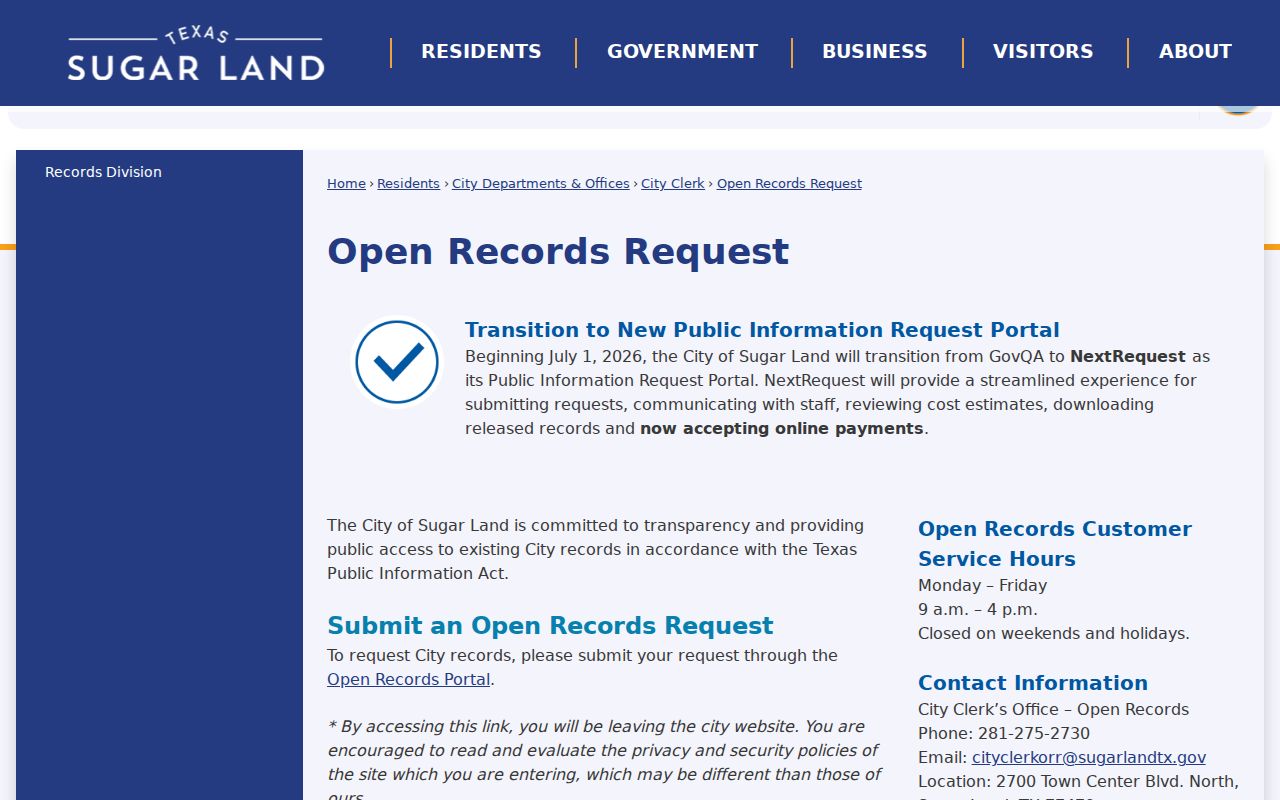
The screen is a request gateway, not a directory result. A clear date range and address or department give the custodian a practical way to locate an existing record.
Historic Sugar Land Resident Trails
Historical Sugar Land research has a useful limitation: the inspected TSLAC holdings did not show a standalone Sugar Land household city-directory run. That gap matters. Digitized statewide post-office lists identify Sugar Land as a Fort Bend place name, but they do not name household occupants. The fuller historical route moves through newspapers, burial records, census geography, county documents, maps, and archival collections.
George Memorial Library in Richmond maintains Fort Bend genealogy and local-history resources, including obituary and burial material. Its obituary database can return names, dates, cemetery information, notes, and scans when available. Its newspaper coverage differs by title and period, so an empty result does not establish that no obituary or person existed.
Sugar Land Memory Sources
Sugar Land history also explains why the resident trail is spread across custodians. Fort Bend County historical series reach into early county records, while city incorporation came later in 1959. Rice University’s Sugar Land archival series spans 1827-2006 and includes maps, photographs, newspapers, schools, churches, directories, and resident-related papers. Materials are off-site, so a request should name the subject and date range.
The city’s Sugar Land 95 memorial documents a historical layer of local memory, including identified and unknown burials connected to convict-leasing history. It is historical documentation, not a source for modern residents. Keeping those contexts separate prevents a compelling local record from being used to make an unsupported present-day claim.
Sugar Land Obituary Date Checks
The Fort Bend obituary database is a useful Sugar Land residents source for a past household, but it is not a current directory. Search results may supply a name, dates, cemetery, notes, and an obituary scan when one is available. The underlying newspaper coverage is specific: Rosenberg Herald ran from 1909 to 1958, Texas Coaster from 1912 to 1958, Herald-Coaster from 1958 to 2007, and Fort Bend Herald from 2007 forward. A missing result can reflect an unindexed issue, a spelling variation, no obituary, or a scan that is not available.
Use the library’s wildcard and Boolean search options before treating a result as absent. A cemetery, newspaper date, age, relative, or street or community reference can help separate same-name people. Then compare the lead with a burial volume, public vital index, deed, or probate record. This process keeps an obituary in its proper historical role and avoids turning a single notice into a claim about a living person or a current Sugar Land household.
- Try initials, maiden names, and spelling variations.
- Record the newspaper title and publication date.
- Save the cemetery or relative detail as a second identifier.
- Use an underlying image when the database provides one.
Sugar Land Records Access Changes
Record research is date-sensitive because the access route can change before the underlying record does. Sugar Land announced its move from GovQA to NextRequest on July 1, 2026. Fort Bend CAD identifies the current 2026 certified appraisal roll, which means a property result should retain its roll year and certification note. The District Clerk also carried a 2026 notice that re:SearchTX had technical issues and directed users to contact the office. A portal result without an access date can become hard to reproduce.
Before relying on any live search, save the URL, access date, portal status, coverage statement, fee or account requirement, and the record fields actually displayed. If the online route is unavailable, use the named office or a written request for the existing record. This simple capture habit separates a reliable Sugar Land records note from an old search snippet and makes it easier to explain why a later search behaves differently. It also preserves the distinction between a current parcel display, a historic document image, and a portal notice that only describes how access worked on a particular date and which source field names were visible.
Sugar Land Court Search Paths
Court names can be verified through separate systems. Sugar Land Municipal Court handles Class C matters within city limits, Fort Bend Odyssey provides county case searches, and the District Clerk’s QuickLink route covers historic criminal, civil, and family indexes from 1821-1980. A case result must be dated and read through its register of actions or final order. An arrest, charge, docket entry, and disposition are different facts.
Municipal tickets may take one to three business days to appear, and final dispositions five or more years old are removed from that online display. County portal results have their own coverage and redaction limits. Court research can corroborate a party role, but it should never be used to make a claim beyond the actual final record.
| Official route | Best use | Key limit |
|---|---|---|
| City Municipal Court | Class C city matters | Online age limits apply. |
| Fort Bend Odyssey | County party and case search | Use the register and final record. |
| District Clerk QuickLink | Historic 1821-1980 indexes | Series and purchase access vary. |